Showing posts with label film noir. Show all posts

Wednesday, August 10, 2011

Living In the Past

On today's docket, a couple old films.


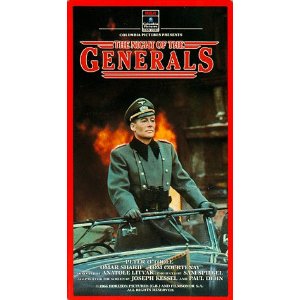
First, one of my favorite old films, Anatole Litvak's 1967 thriller The Night of the Generals.

The story involves three Nazi generals, one of whom is involved in the serial murder of prostitutes. The generals, Kahlenberg (Donald Pleasance), von Seydlitz-Gabler (Charles Gray) and Tanz (Peter O'Toole) are all suspected, and all three are unaccounted for at the times of the murders and each is concealing something. The tumultuous events of WWII serve as an improbable backdrop, less for the crimes themselves--what could be less shocking than murder in wartime?--but for the dogged investigation into the murders undertaken by the zealous fellow Nazi Colonel Grau (Omar Sharif), who insists that justice means nothing if members of a class can exempt themselves from its mandates.

In itself it's a fascinating setup, but it's made most compelling by the central performances. While there is some late '60s period filmmaking cheese at the perimeter, the central figures are quite magnetic, particularly Omar Sharif as the good-natured but almost manically-focused Grau. Even as he is taunted--and frankly warned--about his obsession over such peripheral matters while Germany is struggling for its existence, he will not, cannot, be sidetracked. "Above all, Major Grau, not too much zeal," he is warned by a colleague when Grau insists on confronting the three men (who have systematically refused to see him) at a cocktail party. "I have a zealous nature, sir; I can't help it," he says congenially.

The other standout performance--the real star of the show--is Peter O'Toole as the magnificently pathological General Tanz. As the quintessential Nazi, "the pet of Hitler," as he is called, Tanz is dogmatic and brutal, and manically rigid. Or just a plain maniac. He is obsessed with cleanliness and comically devoid of social graces, such that one waits mid-cringe for the next little blowup that follows inevitably in his wake. Unfortunately for the rest of the world, Tanz has the power to indulge all but the most savage whims with impunity--and, with a little care, those as well.

(As an aside, I vaguely remember seeing the film 30 years ago, and I daresay it was seeing a bald Donald Pleasance in huge Birth Control Glasses that grabbed something deep in my brain stem and gave it a good shake: I identified with this look on some unutterable level--and indeed I still do. Apart from slightly toned down glasses--a recent development--I adopted the look almost immediately and have found my stylistic home ever since. Pity I couldn't find a better role model than a wacky Nazi general, though I daresay Kahlenberg is the sanest of the group here. That's my story and I'm sticking to it.)

Mixed up in the story is the historical plot to kill Hitler in his bunker and sidestep his hand-picked successor in favor of a saner government, a situation covered recently in Bryan Singer's 2008 film Valkyrie. But those events play at the edge of The Night of the Generals, and that eccentricity is kind of the film's point: even as high Nazi officials are trying to murder Hitler, a dogged investigator continues to probe the murder of a couple prostitutes. I saw it on some TV rerun in my early days of college, and I looked for the film in VHS and DVD catalogs for years to no avail. I was thrilled to find it recently available on iTunes. It's not a film that deserves the very highest grade, but it's a worthy effort and an excellent entertainment (if this is your thing). For brilliant performances and a wonderful period feel I would give it a solid B+.


The other film is new to me, Edward Dmytryk's 1947 film noir Crossfire.


The film stars three Roberts: Young, Mitchum and Ryan. Mitchum and Ryan are servicemen back from the battlefields of WWII who, with a collection of soldier friends, find themselves mixed up in the murder of a civilian, a man scarcely known to any of them. Robert Young plays a detective who is trying to get to the bottom of the murder, trying to figure out who is responsible in a group of men who are frantically--and often unthinkingly--trying to look out for each other (as perhaps they have had to spend the last four years doing). Both Young and Mitchum play cynical men who have seen it all and are tired of life. But each is also intelligent and observant and almost impossible to catch off guard, and it is the strength of these two performances that carry the film. The supporting actors are not weak by any means, but Young and Mitchum are deeply satisfying, giving the kind of performances that make me want to watch a film in the first place.

A lot of really wonderful films came from B Movie reels, especially noir films. Noir films are known for an emphasis on style, particularly lighting, and the lower budgets often give the films a play-like quality, forcing them to concentrate the story on small sets and in verbal exchanges between people rather than in broad action or battle scenes. The deep shadows of Crossfire's opening scene sets the mood instantly, as does the cynicism and world-weariness of all the main characters--these things are very noir. I especially like the way the soldiers are portrayed here, as generally good kids who have been through hell and have come out the other side with much of their baby skin scrubbed off. It seems a very mature and measured thing in 1947 to recognize the essential goodness of a soldier's task in this war while at the same time refusing to give anyone a free pass on that account. It also seems visionary to grapple, if just a little, with what it is to return from the hell these guys lived through and try to set up a normal life in the aftermath. This last angle doesn't get much play, but at a time when I suspect jingoism was running rampant it's refreshing to see the cold water of reality splashed on things. These men's accomplishments are not diminished by acknowledging the difficulties they face after the fact.

The film ultimately grapples with racism, though in the form of the battles among white man's clans (this is still a world where dealing with prejudice against nonwhites was nowhere near on the table, even if it is exactly the same argument; that would take several more decades). But it's a plot point that's kind of sneaked in through the side door and apart from one of Young's speeches it's not too fervently handled (idealism of any kind is really at odds with noir sensibilities). The rest is just a good old fashioned detective story, a whodunit with great characterizations, high-contrast lighting and lots and lots of smoking. What's not to like in that?

Grade: B

Saturday, June 2, 2007

Depends What You Mean By "Good"


What the hell is this movie about? I've just finished my second viewing of Stephen Soderbergh's The Good German, and I'm trying to decide whether it all slots together or not. I'll warn for those interested that I'm about to stomp publicly all thru the plotline, so no secret will be left unturned (except all the ones I'm too dense to have figured out--so maybe you're all safe after all).

Set just after the cessation of European hostilities in the Second World War, the movie begins with journalist Jake Geismer (George Clooney) emerging from an airplane in Berlin on the eve of the Potsdam Conference which will decide the details of Germany's surrender and the postwar fate of Poland. Tobey McGuire plays Tully, Geismer's driver and a corrupt tool of an American soldier who is taking advantage of the thriving black market in postwar Berlin. Cate Blanchett plays Lena Brandt, the wife of a shadowy absentee German of increasing interest to both the Americans and the Russians in the divided city. Lena Brandt was Geismer's mistress when he was last in Berlin, and is currently Tully's mistress, though neither man is aware of this at first. It may or may not be a coincidence that Geismer would be assigned a driver on his return to Berlin who is currently sleeping with his former mistress who happens to be the wife of a person significant to postwar Germany. This just seems a bunch of connective tissue that doesn't bring us anywhere, shit thrown at us to muddy the waters, and, for me anyway, not necessarily to good effect. If the significance of a detail can only be sussed out with a spreadsheet--or a rambling, narrative blog post--then it's maybe a step too complicated for me. We'll see. (Maybe I need to stick with, say, Titanic: 1. big boat hits iceberg; 2. big boat sinks; 3. everyone dies. I can follow that.)

Tully's mistress turns out to be more interesting than he knows (or than Jake Geismer knew), a fact made plain when he is beat up coming into her apartment by men who are looking for Emil Brandt, Lena's husband. Tully knows nothing of Emil Brandt--he doesn't even know Lena's last name, let alone her marital status--and Lena insists when he angrily tracks her down (and punches her in the gut) that her husband is dead. Undeterred, the always-enterprising Tully decides that if the Americans are seriously hunting for Mr. Brandt, then he, Tully, might be able to profit from selling the missing mystery man on the black market to the Russians. Though he does not have Emil Brandt, and doesn't even know whether the guy exists, he goes to the Russian sector to make a deal, hoping that the advance on his contract to produce the mystery man will be enough to get himself and Lena out of the country, presumably before the shit hits the fan. The Russian General agrees to Tully's offer of 200,000 dm for Mr. Brandt, and agrees to advance half that sum as a downpayment. "Come back in two hours. And bring Mrs. Brandt," he says. Tully goes off to round up the reluctant Lena.

In the next scene Tully is found floating in the river in the Russian sector, dead. Later Lena claims that SHE murdered Tully, and our last encounter with him has him beating up George Clooney and putting Lena by force into a Jeep to take her to the Russians. So did she do it? She has a mysterious and icy demeanor, an aspect of someone who has seen and done too much, so we can believe it. But Tully was found floating in the river with a zillion deutschmarks on him; so did she kill him after the Russians met and released her? If she shot him to avoid being taken to the Russians--there seems little reason to trust that they'd just talk to her and let her go again, especially if they were willing to pay a small fortune for her husband--he wouldn't have the 100,000 dm on him. I'm stuck on this detail. And further complicating things, there's a little forensic detail courtesy of Jake Geismer where he shows that the money on Tully came from the American sector (not, as one would have expected, from the Russians who are supposed to have given it to him), but the light about the significance of this detail has not come on for me yet. The basic idea is that he went back in two hours as he was instructed, and that he brought Mrs. Brandt with him; otherwise, how would he have that money? But why is it not Russian money? (Feel free to jump in here and tell me what must be plainly clear to anyone else.)

The US and Russia are both looking for Lena's husband, ostensibly because he's part of the German rocket program which they want to import to their own countries. He's officially dead--the Russian general claims to have seen his death certificate--but Lena is keeping him alive in a subway tunnel. But what he and she want vis-a-vis their marriage and the husband's safety is not made clear. Clearly they're trying to keep the husband from being scooped up by some group or another, but specifically why is left rather murky. Surely the four parties occupying sectors of Berlin would not equally desirable hosts. The Americans and the Russians both claim to want brains for their rocket programs, but the Allies are also wanting to bring prominent Nazis to justice. Lena's husband was an SS officer, yet the American bigwig implies, when plying Clooney for help in getting Emil Brandt into American custody, that wearing the uniform did not necessarily a Nazi make. Is that really what he thinks? Is Emile's rocketry expertise really what the Americans are after?

And what of Emil? What does he want? In one of his few vocalizations, he is insistent that every German citizen must stand up and tell the truth, and must atone for the country's atrocities, that everyone must own up to what they have had a hand in, as this is the only way back to civilization for the country, the culture, the citizens. Lena calls her husband "a good German," and his new mission statement sounds noble enough. But he had a hand in designing the secret concentration camp where rockets were built, a camp where the inmates were calculatedly worked to death--indeed, he helped to determine just how much work each person would be good for before they had to be replaced with another prisoner. So his goodness is is an open question. Why doesn't he atone for his crimes by turning himself in to the occupying authority for questioning and possible criminal prosecution? What he is trying to do, beyond survival and maybe getting out of Berlin, is not clear. That he is on the run and in hiding IS clear. Lieutenant Schaeffer, the brutal blond American who escorts Jake Geismer from the riverbank in the Russian sector, tries to kill Emil Brandt at the end (and is presumably the guy who beats up Tully in his quest to find Emil Brandt). Why does he want him dead? Doesn't he want him for the American rocket effort? Or to bring him to justice? Why would he undermine Brandt's desire to atone for German sins? Or is that not really Emil's desire? And is the guy who actually kills Emil working with Lt. Schaeffer?

Maybe it's Lena who is the "good" German. She's a Jew whose whole family died in the camps, and who stayed alive by ratting out other Jews to save her own skin, surely something of value to the Nazis, and the kind of state-sponsored racial vigilanteism that would have marked a person as a good citizen under Nazi rule. From the beginning of the movie Lena wants out of Germany, and is trying to enlist the help of anyone she comes across to buy or steal or forge the necessary paperwork. Yet no mention is made of her trying to get her husband out of the country; au contraire, she pointedly says at one point that she wants to get out without her husband. What's up with that? Does she not love him (she seems to love him, or at least not to dislike him)? Well and good, but then why put yourself at such risk to help him? Is it that he is truly good at heart and she feels irredeemably soiled by her experiences? Nah. So what's really going on with Lena Brandt? Everyone remarks that people did terrible things during and after the Nazi regime just to survive. But while selling out other Jews might work to put Jake Geismer off of her, it doesn't explain why the American Attorney General has a file on her, or what terrible things are in her file that would give them ample cause to imprison her for life (as he claims). Ratting out other Jews could hardly be of moment to the Americans, no? Yet that's her Big Confession to Jake in the final scene. Really?

Aesthetically I loved the movie, but I'm partial to black and white. I read that Stephen Soderbergh used vintage equipment and techniques to match the look and feel of the existing newsreel footage, which is interspersed with the new footage, and of the classic film noirs which were made at the time. Thomas Newman has another interesting score (I especially loved his work in Road to Perdition), harking back to the movies of the 40s. Several of the scenes seemed a bit amateur-ish in their acting. Tobey McGuire's character seems, to me, not quite believable, and Lena Brandt's roommate always seemed to me like an actress trying to sell her lines. At first I thought that George Clooney was too pretty and pat for the role, but I liked him better the second time thru.

At this point I'm left with a few too many questions to turn both my thumbs up. Maybe this will all come to me in a rush when I realize that I've hugely overlooked some very salient detail that pulls the whole business together like the magic twist of the Rubik's Cube. And if that happened, I think the movie would rate a strong B+; but until I can pull some coherence from the fog of my 4:am brain, I have to give it a C+.

Thursday, October 12, 2006

Mr Wilder, I'm Ready For My Gruesome Murder


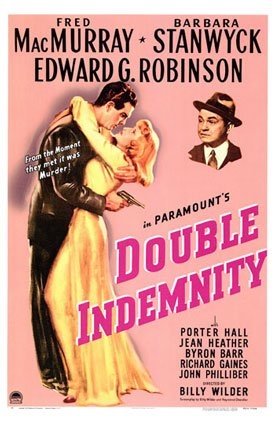
I've been watching the special edition of Double Indemnity, the seminal 1944 Billy Wilder noir film about insurance fraud and murder.

I'm not very comprehensive in my knowledge of film noir, but I know what I like and I figured out a decade ago that I rarely see one without being taken in by the dark subject matter and fabulous visual style. Robert Osborne in his introduction cites Double Indemnity as the official beginning of the film noir movement (a movement which was not identified as such until some 20 years later), and one of the movement's best. In fact, it's a fantastic film regardless of genre. It's perfectly cast, wonderfully paced, and visually innovative. And the story is compelling with minimal adjustment to period.

I made it through high school and into college before I really paid any attention to the visual aspects of anything. And now, having blinkingly discovered this side of life as an adult, I'm more attached than I might otherwise be. I love looking at the world as it used to be, the gritty depiction of the America of my grandparents' youth. This is a world where the fresh-scrubbed picture of society from the WW2 propaganda pictures comes crashing down, a world where people are weak and life is harsh. No spin doctors here. Hotels have their own detectives. Nobody seems to like daylight. Everyone smokes and drinks and cheats on their spouse. It's always raining.


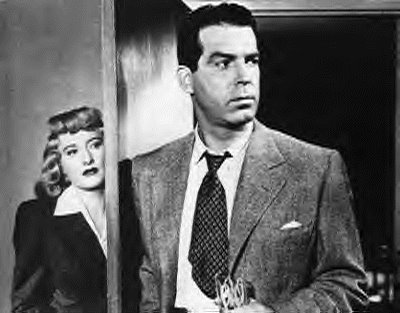
Color was newly available to movie makers in 1944, but with Double Indemnity black and white was conscientiously chosen and made a character in the movie. In what became a pattern for noir films, much of the action occurs at night and everything takes place obscured by deep shadow and in a haze of cigarette smoke. The main noir character is often a man at odds with society, someone misunderstood and often feared or despised. The story is told from the point of view of the criminal; the movie's whole perspective is that of the criminal element--we are practically encouraged to root for the anti-social. Fred MacMurray's character, insurance agent Walter Neff, is generally sympathetic--moreso than with many noir characters--but Barbara Stanwyck more than makes up for it. In any case, we have a front row seat for a series of bad decisions which result in his seemingly-inevitable slide to the dark side.

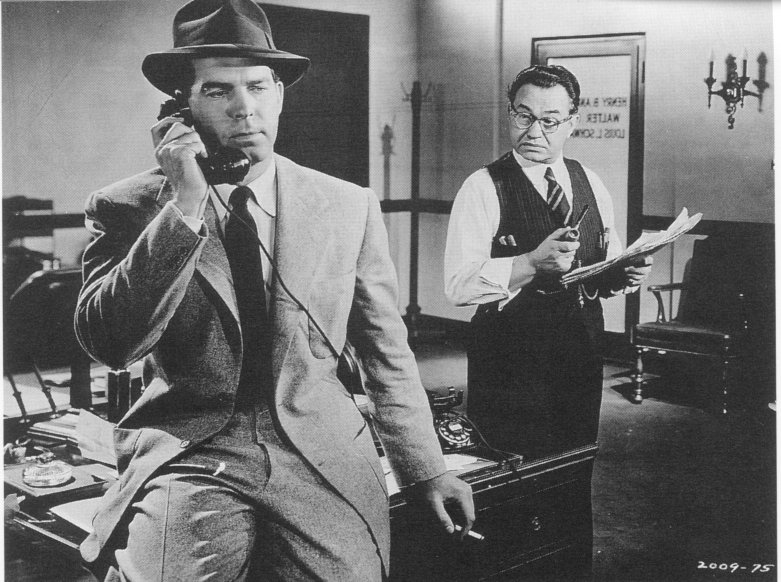
For those not already familiar with the story, Barbara Stanwyck is married to a stuffy oil executive, and decides, with a little help, to make sure his accident insurance is in order and then have him knocked off for a big payday (this story--adulterers committing murder for money!--while it may sound commonplace in 2006, is a steel toe to the groin of polite, churchgoing 1944 society). The help comes in the form of the cast-against-type MacMurray, who is lured as they always are to the femme fatale, and to his stumbling downfall. Is it love? Infatuation? Hubris? The thrill of the chase? Walter Neff dabbles in all these things, and is convinced that, being an insurance man himself, he can perfectly fool the system. But the deception is smelled out by Claims Manager Barton Keyes, who is a close personal friend and coworker of Neff. And, of course, nothing ends up being quite what it seems initially, and worlds collide. It's cat and mouse, with a bit of detective intrigue thrown in.


It's the relationship between Walter Neff and Barton Keyes that really makes the movie, and indeed the role of Barton Keyes was juicy enough to lure headliner Edward G. Robinson to accept a supporting part. This is, in an unorthodox fashion, the love center of the movie. They're not lovers, of course, but only close friends; but without this source of warmth, we could not gauge Neff's fall nor the icy emptiness of Phyllis Dietrichson. Barton Keyes is a blustering, cranky bully, and yet Robinson manages to play him with great subtlety and absolute conviction and it's a thrill to watch. Barbara Stanwyck was also at the top of her game--she is cited by one of the film historians in the DVD's special features as perhaps Hollywood's greatest actress of all time--and this polish and confidence is played against Fred MacMurray, who was still relatively unknown and a man personally opposed to playing so unsavory a character. MacMurray's essential goodness plays well here, and makes his slide a bit awkward and more believable.

It takes the older movies--movies which were so much a product of the restrictive production codes of the time--to show us how badly our modern action flicks miss the mark. Hollywood so often fails utterly to grasp the concept that less can be much, much more. This movie is all about the story--not about the size of the explosions or the body count. It's about temptation and inner conflict; it's about the dark corners of the human psyche and the frailty of human will. The whole story is about the anticipation of what might happen, and our hope that the inevitable might be averted. This is a movie which I would strap Jerry Bruckheimer down and force him to watch again and again until some sense of subtlety and aesthetic sophistication oozed osmotically into his over-caffeinated, television-raised psyche.

I give this one an A+