Showing posts with label travel. Show all posts
Sunday, July 2, 2017
Hong Kong
This is yet another continuation post to the two previous, detailing some of my impressions about China stemming from our recent vacation there. Specifically, I'm interested in the special case of Hong Kong.
Though obviously a Chinese city, it was a part of the British Empire--governed and administered by the British--for a hundred years until being handed back over to Chinese control in 1997. And so it's always had a hybrid feel, a city of (mostly) Chinese people living under British ideas. And under that working arrangement it has attained an iconic status, like New York or London.
But my sense is that there has always been some tension there between West and East, and the handover of the territory back to Chinese control was the subject of much angst: China felt the territory was rightfully theirs (taken from them by unfair treaties) and most of the residents did not consider themselves to be Chinese and were very happy governing themselves. As an airline person, I remember reading about Cathay Pacific's concerns that Communist China would not honor the sovereignty of the profitable and thriving business at handover, and I believe serious consideration was given to moving the headquarters of the airline out of the region.
I found myself lounging on my hotel bed in the Tuve Hotel in Hong Kong reading a New York Times article about just this subject the day before we left to return home. The gist of the article was that Chinese authorities promised to honor Hong Kong's independence after control was returned to China--what China calls "one country, two systems"--but that, unfortunately, is not really how things are unfolding 20 years on.
I've always held Hong Kong in special regard, but this is based on my visitor's impressions rather than any scholarly expertise. On this trip we spent five days in Beijing and a couple days in Xian (another Chicago-sized city of which I've barely heard), and like all other major Chinese cities these places are abuzz with construction and growth and activity and change. Hong Kong is too, of course, though in that case it doesn't represent a change from the status quo. The larger sense is that China is a country massively on the move. And so Beijing very likely thinks it can manage growth and business quite well, thanks, and perhaps that there's no need or justification for Hong Kong's special status. More than this, to acknowledge Hong Kong's special spark--to acknowledge that its differences contribute to its spark--is to imply that other Chinese cities could follow the same model. That's clearly not immediately in the cards--although modern China is hardly recognizable from what was here 50 years ago. The NYT article says that some in China feel that HK suffers from "too much democracy." Residents of the city, naturally, resist this characterization.
So where does that leave Hong Kong? Right now, kind of stuck. Beijing has actively removed several democratically-elected politicians of whom it does not approve, and even gone so far as to abduct under cover of darkness those--liberal booksellers, for example--it considers to be threatening. All of this is a nightmare for residents who having let the fox into the henhouse are really left with few options.
Meanwhile, several massive projects are on hold because the two sides cannot agree on how to proceed. One has to think this all leads inevitably toward their not being "the two sides."
Much as I love HK, I find I'm torn. As a socialist, I think putting the reins on capitalism is sensible and utile. And I'm unqualified to see how much of HK's brilliance is due to laissez-faire economic policy--and I certainly don't KNOW that HK will be a different or less attractive place when Beijing gets its way. But OTOH I feel like people ought to be able to determine their fates, and it's hard for me to see how Beijing's control will benefit HK or its citizens. In any case, Beijing seems unlikely to back down--especially when they're doing so well in other places. I fear--and I'm obviously not alone in this--a place I love will be snuffed out and turned into something much less vibrant.
At the very least one feels that Beijing cannot be taken at its word, and that no success in HK will shake the elite of the Communist Party from their positions of power.
Saturday, July 1, 2017
China
(This post kind of continues on from the previous post--and is followed by a kind of Part III about Hong Kong.)
We’re on a two week vacation in China.
I’ve been here often before. Well, I’ve been in the country many times before, but I’ve only visited a handful of cities in what is after all a vast and diverse place. Most of my time has been in the Pearl River delta—Guangzhou, Shenzhen, Hong Kong—and further North in Shanghai. And I’ve spent a little time in Chengdu and now, recently (upon changing airplane fleets) a couple new places: Zhengzhou and Qingdao.
I’ve been in love with Hong Kong since my first visit, and I’ve been trying to get Susan to come here for a decade. (She does not inherently share my fascination with the country, and she’s needed time and persuasion to take on the 13-hour flight.) She finally agreed provided we also spend some time in places I had not previously been. She suggested Xian (to see the Terracotta Army) and I suggested Beijing. And the trip would end with five days in Hong Kong.
And so it has gone. We’re currently on Day Three of five in Hong Kong after having a spectacular visit to Beijing and, after a delay, Xian. These places have been all we could have asked for. In Beijing we saw the Summer Palace and looked around Tiananmen Square and the outside of the Forbidden City, made a trip to Mutianyu and the Great Wall, toured the National Center for Performing Arts, wandered the 798 Arts Zone, explored the subway system (the largest in the world after Shanghai, which is only fractionally bigger), wandered the famed hutongs. Weather cooperated brilliantly, and our only snafu was getting out of Beijing at the end. Everything canceled due to bad weather and we ended up having to spend an extra night at a roach motel at the airport—which after all gave us one of our best meals in a cafeteria-style hotel restaurant.
This left us a day short in Xian, and we debated whether we shouldn’t just head straight to Hong Kong. But we didn’t want to miss the Terracotta Army, and China Eastern was not very accommodating about changing our tickets. So we got out the next morning, about 20 hours late. But everything then went like clockwork and we were at our (extraordinarily swanky) hotel in Xian by 10:30 that morning. We suggested to the hotel that we still hoped to see the army, and we were told it was no problem at all. Turns out, it may have been better to go around noon (as we did) then to go at 8:AM as we originally planned. It was a hot day and the place was only moderately busy at lunchtime. We immediately met up with a guide who took us through in a couple hours. Afterward, we spent the afternoon walking along the ancient and immense stone wall surrounding the city—some 60’ high and 60’ thick and some nine miles around! Absolutely immense, and one could land an airplane on much of it. We got a great vibe from the city, and I could see spending time here.
The next day we had a three hour flight to Hong Kong and were at our (strange, uber-modern) hotel by about 16:00.
My little bits of exposure to China and Hong Kong continue to kindle my enthusiasm but leave me far from being any kind of expert. I don’t speak a word of the language—something that’s more challenging away from the Southeast where English is fairly common. In Beijing and Xian people’s grasp of English was much more tenuous, making it very hard to communicate at times. And I fear the lack of language keeps everything at arm’s length for a visitor, even a repeat one. Either because of this language limitation or from my natural keep-to-myself travel mien, I’ve visited these places for years without every really talking to a local or seeing any but popular tourist sites and what you can see walking the streets.
Consequently, I don’t really know what life is like for the average Chinese. How are jobs arrived at? Does everyone receive a basic monthly income and can one supplement that by working in a free enterprise setting? And what does the government get out of that free enterprise in return? How do people decide to work in hotels or in little art boutiques or coffee shops or as tour guides? Is the process different from that in the US? And living arrangements: does the government still assign housing? We saw numerous real estate brokers in Hong Kong and the prices perhaps exceed even Manhattan’s. Who buys these? And where do you live if you can’t afford them (that is, how do MOST people find their housing)? I don’t imagine the answers to any of this are especially interesting or intricate, but they play a role in what life must be like in these bustling places for so many of the people with whom we interfaced.
A couple observations: All the Chinese subways I’ve been on have been things to envy. They’re relatively new and constantly growing (virtually every Chinese city I’ve been in except maybe Hong Kong is actively digging subway lines), spotlessly clean, utterly reliable. Trains seem to run (like London) as often as the tracks will allow—one is always leaving as we approach the platform, and the signs never say more than three minutes for the next train—and signage and ticketing could hardly be easier or more comprehensible. How fortunate for us that there’s always an “English” button on the ticket machines and that announcements are always made in English after the Chinese.
Beijing particularly was striking. The system, which is now up to 19 lines and growing (from, I believe, two lines in 2002) carries 10 million passengers per day, for a yearly ridership of almost 3.7 billion. That’s more riders than any other subway system, more than twice what NYC’s subway carries. (Shanghai's numbers are almost identical.) And the Beijing system is being aggressively upgraded and expanded to carry about twice its current numbers.
To me, this seems like but one example of immense spending for the public good. And I can't help noting that it’s exactly the opposite of what we're doing in this country. Rather than pursue aggressive public benefit--since such things are castigated as "progressive" (the *horror!*)--we’re dismantling the federal government and trying to farm its functions out to for-profit concerns. A quick visit to this part of the world shows that in comparison we’re failing at almost everything (except defense spending; I guess that's not an accident).
Every single subway station we were in when in Beijing (maybe 10 stations overall) had 1) functioning, clean bathrooms; 2) uniformed traffic directors / helpers; and 3) a pair of uniformed military personnel monitoring the entrance. There was often a military guy at the main boarding platform on a raised box keeping an eye out. We never saw the military people interacting with anyone, and they didn’t seem there to hassle or discipline anyone. But there is a clear sense that the transportation of people was an important thing that was managed and carefully overseen.
And these things continued in other spheres as well. The National Center for Performing Arts ("the Egg") is maybe the most impressive single building I've ever seen, all in support of the arts--the same programs, more or less, that we're cutting from every school curriculum Republicans can get their hands on. There are public bathrooms all over the place, every two or three blocks, and there are usually people there keeping things clean and picked up. There were no tip jars that I could see when I visited the facilities, so these folks were working for wages paid by someone and not relying on handouts. And it’s hard to overstate how lovely it is to always have a nice bathroom handy as you roam the city. There are people making the rounds of most blocks picking up trash and cigarette butts—I’ve seen this in every Chinese city—and the subway stations were typically being mopped and picked up. There is almost no graffiti, and none at all in the trains or stations (that I saw). Buses are numerous and reasonably new and clean (though we rode them only in Hong Kong).
So what to make of this? All these jobs require money and people. With 1.4 billion citizens--over four times our own population--people seem to be a resource they have well in hand, and many tasks that might be automated in the US (roadwork, say, or manufacturing jobs) are here done by armies of people. But keeping walkways weed- and trash-free is honorable work and very much to the public good, and these armies of workers can be turned toward any task imaginable: building a subway, driving trucks, shipping, manufacturing, construction. But there are some concerns attached to all this: where is the line between functional oversight that, say, makes it possible to have public bathrooms in the subway system and, on the other hand, Big-Brotherism? Surely to some degree everyone here behaves and celebrates the brilliant transit system because punishment for misbehavior is swift and merciless. Vandalizing a public bathroom or public transit has always seemed self-immolating to me, but at what point does preventing that vandalism become oppressive? I suppose this is the age-old exploration of the liberal and conservative mind. This is an authoritarian society, though one which has loosened considerably in the last 40 years, and it's not until I'm here in person that I begin to formulate these questions.
It’s hard for me to have a sense of what life is like for a citizen of Beijing, especially one with worldly ambitions. Hong Kong seems to straddle these two worlds—Communist East and Capitalist West—and it seems to fall in the center of many scales: more public services than we see in the West, but fewer than in Beijing; more oversight / public scrutiny than in the West but less than in Beijing.
For as long as I’ve been coming here I have the feeling that we underestimate China at our peril. They may not do everything well; they may not have everything figured out; their citizens may not top every poll; their culture may not dominate the world: but I cannot put anything past them. They seem well positioned to call the shots in the future—about everything. They are playing a long game, and they have time and sheer numbers on their side. If they don’t yet have the best schools, they soon will; if they don’t have the biggest or most capable military, they soon will; if they don’t dominate business and finance, they soon will. I just don’t put anything out of their reach. And this at a time when the US is clearly and obviously on the decline. Our budgets are perilously out of control, our educational system is only semi-functional, and our popular democratic politics are clearly and obviously dysfunctional. One of our two parties is a disorganized rabble unable to keep its eye on any common good and the other is actively malevolent and corrosive.
Sunday, April 23, 2017
Not Sir Robin's Hood
(Sorry. Written in December and never posted. I have several of these to catch up on.)
I've changed airplanes. After seven and a half years on the Mighty Mad Dog--the MD-11--I decided a change was in order and I've moved over to the Boeing 757/767. (I've been fiddling with another post exploring this move, so I'll save that discussion for that other post.)
One of the benefits to this new position is that the fleet visits many more places than the MD-11 did. The MD-11 is a log-haul heavy jet, a cargo ship of the air that circles the globe but stops in only a dozen or so places. The 767 by contrast goes nearly everywhere. And because the fleet type is really two airplanes--the 757 and the 767, the latter being nearly twice the size of the former--it fulfills every mission, long-haul and short-hop. My company has about 250 airplanes, and nearly 2/3 of them are of this Boeing type. The fleet has extensive flying in the US, of course, but also throughout Europe and Asia and Canada. So my choice of layovers has probably tripled. Given that my fleet change was at least partly motivated by a desire to see and do some new things, this is a most happy turn of events.
This is my first trip after completing the two month rigmarole of training, and my priority was to explore more of Europe. This first schedule is full of places new to me: Vienna, Prague, Budapest, Malmö, Helsinki. And today's destination: Nottingham.
Susan and I were in London for a week a decade ago, but that is the only visit I've made to England. About three weeks ago for my last bit of training we stopped twice in Stanstead (just North of London) and made a quick trip to Birmingham from Germany. Now I have 48 hours in Nottingham.
My initial plan was to just catch a train into London--since, like NYC, I seem unable to get enough of that place. But after a little exploration I decided there is enough to see here that I'd stay put for my layover instead of burning half the day getting to and from London.
One of the first movies I fell in love with when in High School was The Lion In Winter, a loosely historical story of the tumultuous life of Henry II and his three scheming sons and one scheming--and imprisoned--queen. One of the chief attractions of Nottingham is the Castle. It's now an art gallery and history museum, and the building is relatively recent. But the location has figured prominently in English royal history for centuries. Henry II put up one of the first substantial castles on the property, and his squabbling sons, John and Richard the Lionhearted, practiced taking it away from each other after Henry's death. There's virtually nothing of the original structures, of course--it was over 800 years ago, after all--but it's fascinating to stand on the same hill overlooking the town where they and every other British monarch have stood.
I spent several hours wandering the town, including a really lovely section of old and stately homes below and West of the castle (called, I believe, The Park--or more specifically Lincoln Circus).
Here are some photos from the morning's wanderings.
I've changed airplanes. After seven and a half years on the Mighty Mad Dog--the MD-11--I decided a change was in order and I've moved over to the Boeing 757/767. (I've been fiddling with another post exploring this move, so I'll save that discussion for that other post.)
One of the benefits to this new position is that the fleet visits many more places than the MD-11 did. The MD-11 is a log-haul heavy jet, a cargo ship of the air that circles the globe but stops in only a dozen or so places. The 767 by contrast goes nearly everywhere. And because the fleet type is really two airplanes--the 757 and the 767, the latter being nearly twice the size of the former--it fulfills every mission, long-haul and short-hop. My company has about 250 airplanes, and nearly 2/3 of them are of this Boeing type. The fleet has extensive flying in the US, of course, but also throughout Europe and Asia and Canada. So my choice of layovers has probably tripled. Given that my fleet change was at least partly motivated by a desire to see and do some new things, this is a most happy turn of events.
This is my first trip after completing the two month rigmarole of training, and my priority was to explore more of Europe. This first schedule is full of places new to me: Vienna, Prague, Budapest, Malmö, Helsinki. And today's destination: Nottingham.
Susan and I were in London for a week a decade ago, but that is the only visit I've made to England. About three weeks ago for my last bit of training we stopped twice in Stanstead (just North of London) and made a quick trip to Birmingham from Germany. Now I have 48 hours in Nottingham.
My initial plan was to just catch a train into London--since, like NYC, I seem unable to get enough of that place. But after a little exploration I decided there is enough to see here that I'd stay put for my layover instead of burning half the day getting to and from London.
One of the first movies I fell in love with when in High School was The Lion In Winter, a loosely historical story of the tumultuous life of Henry II and his three scheming sons and one scheming--and imprisoned--queen. One of the chief attractions of Nottingham is the Castle. It's now an art gallery and history museum, and the building is relatively recent. But the location has figured prominently in English royal history for centuries. Henry II put up one of the first substantial castles on the property, and his squabbling sons, John and Richard the Lionhearted, practiced taking it away from each other after Henry's death. There's virtually nothing of the original structures, of course--it was over 800 years ago, after all--but it's fascinating to stand on the same hill overlooking the town where they and every other British monarch have stood.
I spent several hours wandering the town, including a really lovely section of old and stately homes below and West of the castle (called, I believe, The Park--or more specifically Lincoln Circus).
Here are some photos from the morning's wanderings.
Friday, August 8, 2014
Within These Walls
Though it has to have been quite recently, I don’t remember when I first heard of the Kowloon Walled City. But it was a place custom-made to capture the imagination. Mine, anyway.
Demolished by the Hong Kong government in 1993-4, the Kowloon Walled City was a collection of some 350 buildings constructed on a couple city blocks’ worth of land in Kowloon near the now-defunct Kai Tak airport. Though it began as a military fort, it grew in recent times into a dense community, a kind of city within a city that, legend had it, existed off the grid, outside regular law and order. At the end, at least, the City was said to be controlled by the Chinese organized crime syndicates known as the Triads (though like many legends of the Walled City this is now disputed). With an official population of 33,000 residents (some estimates put the number as high as 50,000), the Walled City notoriously sported the highest population density on Earth (extrapolated, some 3.2 million people per square mile; that’s considerably denser than the tenements of New York’s Lower East Side, previously thought to take the prize).
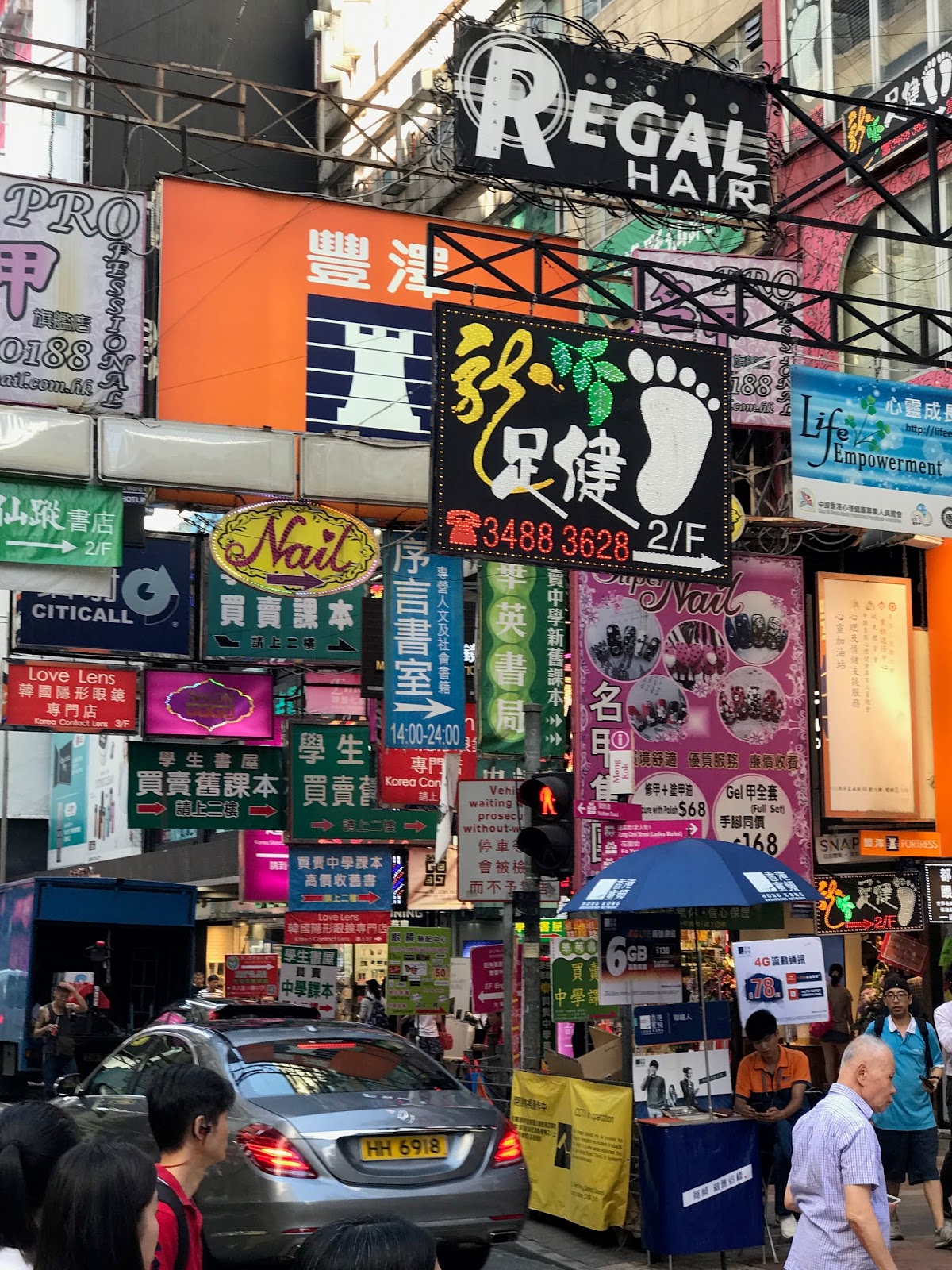
I first flew into Hong Kong when I came to the MD-11 in 2009 or so. The Walled City was long gone by then, but in historical terms I feel like I just missed it. From my first visit to this place I was taken by the grimy back streets and chaotic, ramshackle construction (as my tedious - photos - attest), and in truth there’s a lot of Hong Kong that looks very similar to pictures of the Walled City (our old hotel on Nathan Road is right next to a similar conglomeration of buildings called the Chungking Mansions—I’d never heard of that place either until researching the KWC). There’s a lot of crumbling masonry construction here, and many old residential buildings seem to be kept going by improvised repairs. By our standards, many seem on the verge of collapse, or at least well on their way. So it’s not the construction of the Walled City itself that is odd: it’s how tightly packed it was. You might say the Walled City was Hong Kong only more so. The pictures remind one of the city of Ridley Scott’s Blade Runner, incredibly dense and dark and wet and tangled.
The Wikipedia article details some of the history of this plot of land, and though there was a residential presence for much of the last 80 years most of the construction that housed such a density of people dated from the 1960s-80s. Though Hong Kong was ruled by the British, the Walled City was exempt, an area still under Chinese control. At the end of WWII, Chinese squatters flocked into the City under Chinese protection. The British tried to dislodge them, but eventually washed their hands of the place. Keeping order there was more trouble than was deemed worthwhile. This situation—governance by in-absentia Chinese, and abandonment by the Brits—allowed the drugs and gambling and prostitution businesses to grow unchecked. It also meant that nobody was governing the construction process as more and more buildings were erected (though, interestingly, Wikipedia says that the proximity of the Walled City to the Kai Tak airport meant that no buildings could be built above 14 stories in height; I wonder who agreed to and enforced that rule?). Structures were built wherever they could be made to fit.
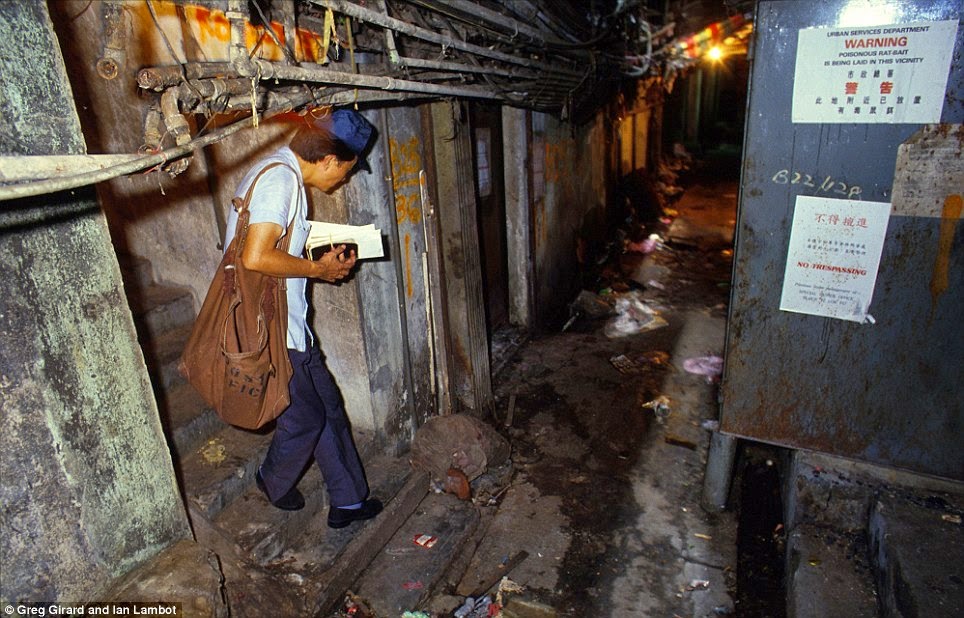
Yet the vice and mayhem existed cheek-by-jowl with pensioners and thousands of families, all crammed into tiny spaces (the article says most apartments were only 250 square feet). It became very nearly a self-contained ecosystem, as most everything a person wanted or needed could be had within the City's walls. Numerous unlicensed doctors and dentists operated there--that is, medical professionals who wanted to avoid the exorbitant licensing fees of Hong Kong (a unique subculture that would be a fascinating study in and of itself) and there were many restaurants and a motley assortment of schools and daycares. There was mail service, though very few people were able to navigate the compound in any comprehensive way (I love the story of the old woman who lived there for years but said she never went anywhere but directly to and from her residence, so she didn’t know the rest of the place at all). Though it seems that several water mains were eventually routed to the City, there were no regular utility services since the city was not involved in the construction. And yet the residents seem to have cobbled together utilities, as the many pictures of bakeries and small factories and tiny apartments with a tap and bare light bulbs attest. But in most cases ad hoc means improvised: pictures show an unruly tangle of wires and pipes and hoses in all the alleyways, many of which leaked so that the dark passages were frequently damp. The alleyways themselves were originally open passages between buildings, but most of them were covered and structures built atop them, so that there were hundreds of internal passageways known only to the residents of each particular section. The rooftops were public outdoor spaces, frequently used by children and by the residents of the upper floors.
I’ve taken pictures in Shanghai of an old part of the city that reminds me of the Walled City, but without the verticality. Many of the structures in this part of Shanghai look to be uninhabitable, and yet clean and smartly-dressed people can be seen incongruously issuing from them. And so it must have been with the Walled City: thousands of children were raised there, leaving their residences inside the walls to walk to school like all other kids. It’s the juxtaposition of these extremes—normal family life next to brothels and drug dens and cookie factories and Chinese bakeries and illegal doctors, all piled on top of each other in incredible density—that the pictures bring home to you. Pictures do so much better than words here. The photos of the exterior show a chaos of birdcage balconies and rooftop porches and a forest of antennas, all crammed together higgledy-piggledy without adhering to any master plan.
At least in theory—setting aside the whole organized crime angle, which would be quite beyond my ken—I would give my eye teeth to explore such a place. Well, there exists the next best thing: I learned that a book of photographs and stories about the Walled City by Britons Greg Girard and Ian Lambot had been published around the time of the City’s destruction. The stories of the people who lived here and the small factories that operated here, all under the radar, in the midst of one of Asia’s premier and most bustling and cosmopolitan cities is one of those stranger-than-fiction things. The book—City of Darkness—is out of print and the few copies available on Amazon were asking some $900. But as luck would have it, the authors are producing a 20-year anniversary edition with substantial updates—City of Darkness Revisited. The reissue project was funded by a successful Kickstarter campaign, and though I missed the campaign I was thrilled to find that I could pre-order the new book from London. Deliveries are expected in September.
I went through a period where I was infatuated with the Kai Tak airport. It was another of those places that could only have existed here, an incredibly busy one-runway airport in one of the world’s densest and most vibrant cities, an airport built on created land which required huge jets to fly very close to—and in some cases below—the skyline of the city. (Do a search on YouTube sometime for “Kai Tak” and you’ll see some spectacular airplane footage.) The spit of land is still readily visible jutting out into Victoria Harbour, now converted to a cruise ship dock and terminal. The Walled City was situated right off the end of the runway, and much of the footage of airplanes scarily close to buildings was doubtless taken from the rooftops of the Walled City, jumbo jets passing in a steep bank, so close you could read the writing on the fuselage. (Many of our pilots have stories of flying in and out of Kai Tak, though it was closed by the time I got hired here.)
About a year ago I walked the five or six miles from our hotel in Tsim Sha Tsui over to look at the remains of Kai Tak (alas, not being able to see much). At that time I had not yet heard of the Walled City, or I would certainly have looked for its remains. Though the Walled City is gone, the city of Hong Kong put up a park on the exact footprint of the old Walled City, called, appropriately enough, the Kowloon Walled City Park. That was the destination for today’s walk. Only a few artifacts remain of the settlement. Several of the entry gates are still there, and there are maps and diagrams throughout the park showing the former locations of things. But knowing it was here is a far cry from seeing it in person. My loss, but luckily a good record of the place exists.
(In addition to Wikipedia, much of this information--and most of the photos--come from Greg Girard and Ian Lambot via their website, and from a Daily Mail newspaper story using the same source.)
Subscribe to:
Posts (Atom)